
Quick answer
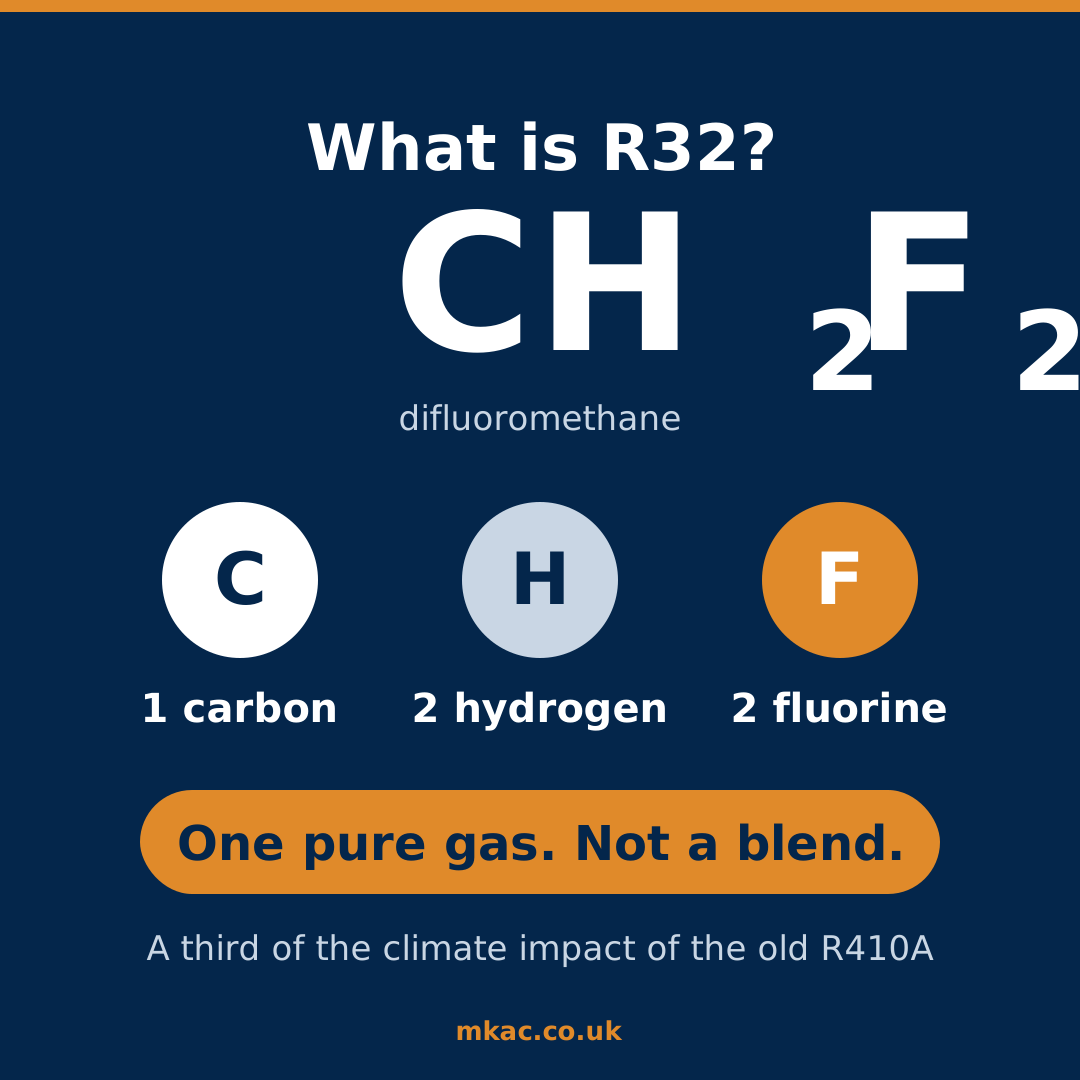
R32 is difluoromethane (CH₂F₂): one carbon atom, two hydrogen atoms and two fluorine atoms. It is a single pure compound, not a blend. The older refrigerant R410A was the blend, 50% R32 and 50% R125. R32 has a global warming potential of 675, about a third of R410A’s, and it does not harm the ozone layer.
What R32 is made of
R32 is the refrigerant industry’s name for difluoromethane. Each molecule is a single carbon atom with two hydrogen atoms and two fluorine atoms attached, written CH₂F₂. Every molecule in the system is the same, so R32 is called a single-component or “pure” refrigerant.
It belongs to a family called HFCs (hydrofluorocarbons). Unlike the old CFC and HCFC refrigerants, it contains no chlorine, which is why it does no damage to the ozone layer.
Is R32 a blend?
No, and this is a common mix-up. The refrigerant R32 replaced, R410A, is the blend: 50% R32 and 50% R125 (pentafluoroethane) by weight. R410A behaves almost like a single gas in use, but as a true single compound R32 is simpler to recover, clean and reuse.
R32 vs R410A at a glance

| R32 | R410A | |
|---|---|---|
| What it is | One pure compound | 50/50 blend of R32 and R125 |
| Chemical name | Difluoromethane (CH₂F₂) | R32 + pentafluoroethane (C₂HF₅) |
| Global warming potential (GWP) | 675 | 2,088 |
| Ozone depletion potential | 0 | 0 |
| Safety class | A2L (lower flammability) | A1 (non-flammable) |
| Boiling point (at 1 atm) | about −52°C | about −51°C |
| Refrigerant charge needed | Smaller | Larger |
| In new UK split systems | The standard today | Being phased out |
Why it matters for your heat pump
- Lower climate impact. If refrigerant ever escaped, R32 has about a third of the warming effect of R410A, and systems hold less of it in the first place.
- Efficient heating in winter. R32 boils at around −52°C at normal pressure, far colder than any UK winter’s day, so it can still pick up heat from cold outdoor air. That is what lets a heat pump heat your home in winter.
- Simpler servicing. As a single compound, R32 can be recovered and reused more easily than a blend.
Is R32 safe in a home?
Yes, when it is installed properly. R32 is classed A2L: low toxicity and only mildly flammable, with a low burning speed that makes it hard to ignite. A home system holds a small amount in a sealed circuit, typically between about half a kilogram and two kilograms, and Haier sets rules on room sizes and pipe routing for it.
By law, only an F-Gas certified engineer can work on the refrigerant circuit. We pressure test every system with nitrogen, pull a deep vacuum and leak check it before handing it over, and record the readings on your commissioning certificate.
How much R32 is in my system, and does it need leak checks?
Refrigerant is measured in CO₂ equivalent: kilograms × GWP. A system holding 1.4kg of R32 is 1.4 × 675 = about 0.95 tonnes CO₂e. Under F-Gas rules, systems below 5 tonnes CO₂e (about 7.4kg of R32) do not need statutory periodic leak checks, so no home system we fit does. An annual service is still needed to keep Haier’s warranty.
Every Haier system we install runs on R32. See what one would cost for your room, with an itemised price in about two minutes.
Get an instant quoteCommon questions
- What is R32 refrigerant made of?
- R32 is a single compound called difluoromethane, chemical formula CH2F2. Each molecule has one carbon atom, two hydrogen atoms and two fluorine atoms. It is not a blend of different gases.
- Is R32 a blend?
- No. R32 is a pure, single-component refrigerant. The older refrigerant R410A is the blend: 50% R32 and 50% R125 by weight. Because R32 is a single compound, it is simpler to recover and reuse.
- What is the difference between R32 and R410A?
- R32 has a global warming potential of 675, about a third of R410A’s 2,088. It also transfers heat more efficiently, so systems need a smaller refrigerant charge. R32 is classed A2L (lower flammability); R410A is A1 (non-flammable). Most new split systems in the UK now use R32.
- Is R32 safe in my home?
- Yes, when installed correctly. R32 is classed A2L, meaning it is only mildly flammable and hard to ignite. Home systems hold a small charge in a sealed circuit, and manufacturers set minimum room sizes and installation rules for it. It must be handled by an F-Gas certified engineer.
- Does R32 damage the ozone layer?
- No. R32 contains no chlorine, so its ozone depletion potential is zero.
- Does my R32 system need leak checks?
- Under F-Gas rules, systems holding less than 5 tonnes CO2 equivalent do not need statutory periodic leak checks. For R32 that is about 7.4 kg, far more than a home system holds. An annual service is still needed to keep the manufacturer’s warranty.